

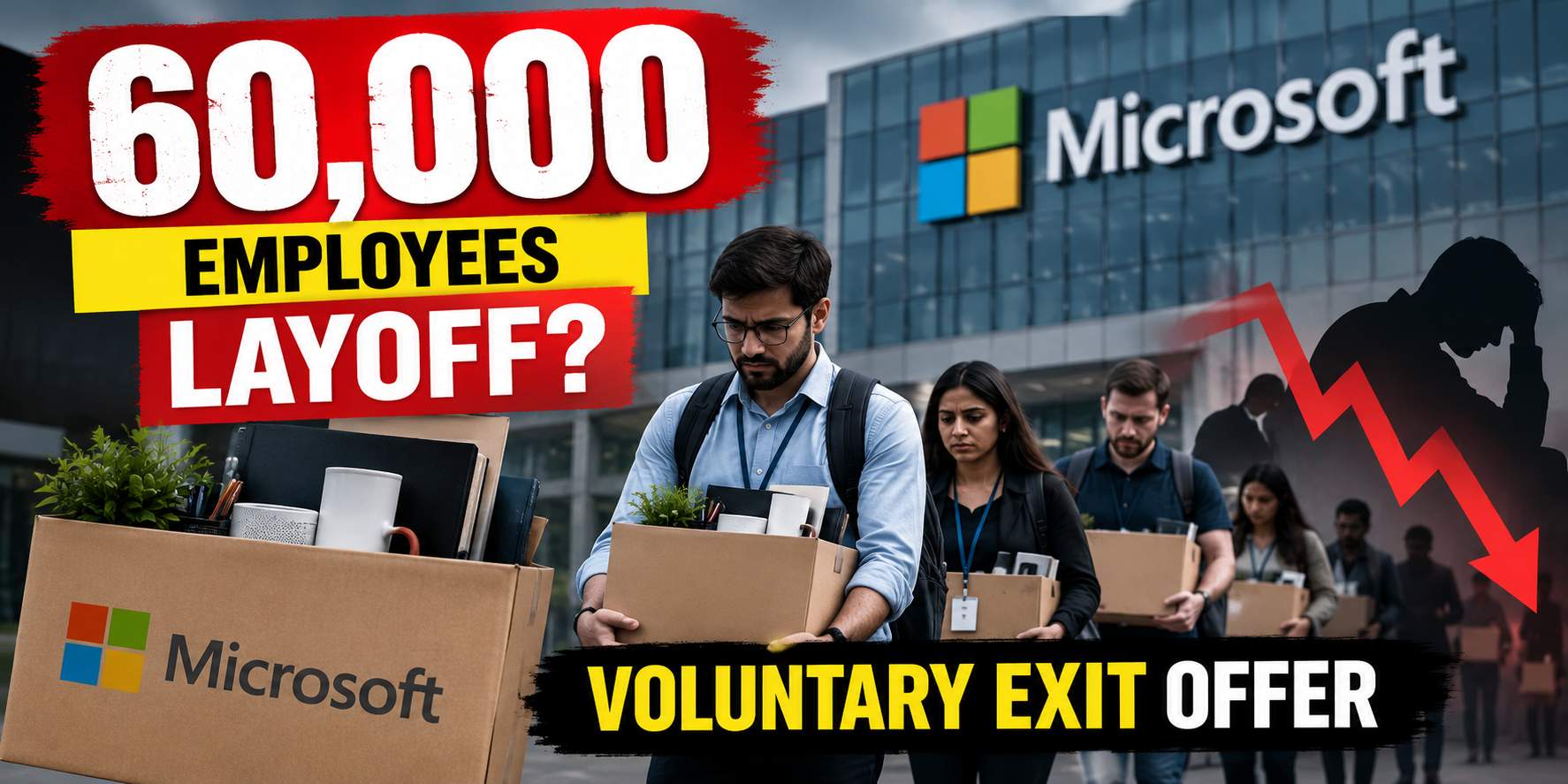
Microsoft Voluntary Exit Offer 2026: 60,000 Employees Eligible — What It Means for Indian Employees
Published: October 28, 2026
Microsoft has introduced a new Voluntary Exit Offer (VEO) that could affect approximately 60,000 eligible employees across its global workforce. The programme comes as the technology giant continues to invest heavily in artificial intelligence (AI), cloud infrastructure, and next-generation technologies.
The announcement has attracted significant attention because the offer covers a substantial portion of Microsoft’s workforce, including eligible employees in India, the United States, the United Kingdom, and Canada.
However, this is not a traditional mass layoff announcement. Microsoft is giving eligible employees the option to leave the company voluntarily with financial support and career-planning resources.
In this article, we explain Microsoft’s Voluntary Exit Offer, eligibility criteria, potential benefits, the impact on Indian employees, and what this development could mean for the future of technology jobs.
What Is Microsoft’s Voluntary Exit Offer (VEO)?
The Voluntary Exit Offer is a programme that allows eligible Microsoft employees to choose to leave the company under specified exit arrangements.
Microsoft announced the initiative on October 26, 2026, through a communication from Amy Coleman, its Executive Vice President and Chief People Officer.
According to the announcement, the programme is designed to give employees who are considering opportunities outside Microsoft another option to plan their career transitions with support.
The company also intends to use the programme to adapt its workforce to changing business requirements.
Unlike compulsory layoffs, participation in the VEO is voluntary. Eligible employees can review their individual offer and decide whether to accept it.
Key details at a glance:
- Company: Microsoft
- Programme: Voluntary Exit Offer (VEO)
- Employees potentially eligible: Approximately 60,000
- Total global workforce: Approximately 223,000 employees as of June 2026
- Countries covered: India, the United States, the United Kingdom, and Canada
- Eligibility: Employees at internal level 70 and below in participating organisations
- Purpose: Provide a supported exit option while helping the company adjust to changing workforce needs
- Financial support: Based on the terms communicated to each eligible employee
The 60,000 figure represents employees who may be eligible for the offer, not the number of employees expected to leave Microsoft.
Why Is Microsoft Offering VEO to 60,000 Employees?
Microsoft’s announcement comes at a time when the company is making substantial investments in AI infrastructure and related technologies.
The company is developing and expanding products and services involving artificial intelligence, cloud computing, AI assistants, and enterprise software.
These investments require significant spending on computing infrastructure, data centres, specialised hardware, and AI development.
At the same time, technology companies are reviewing their organisational structures, employee requirements, and operating costs.
Several factors help explain the context surrounding Microsoft’s latest initiative.
1. Increasing Investment in Artificial Intelligence
Artificial intelligence has become one of Microsoft’s major strategic priorities.
The company is investing in AI-powered products and services, including Microsoft Copilot, Azure AI, and tools designed to help businesses automate tasks and improve productivity.
As AI adoption increases, companies are reassessing the skills, teams, and organisational structures they need for future growth.
However, Microsoft has not explicitly stated that AI replacing employees is the reason for this voluntary exit programme.
2. Workforce Restructuring
Large technology companies regularly reorganise teams to reflect changing business priorities.
Microsoft’s VEO provides participating organisations with another option for adjusting their workforce without requiring every departure to happen through compulsory layoffs.
The programme follows Microsoft’s earlier voluntary retirement initiative in 2026 and comes after other workforce reductions during the year.
3. Managing Operating Costs
Developing AI infrastructure requires substantial financial resources.
Microsoft must balance its spending on technology development, infrastructure, employees, and other business operations.
Offering voluntary exits may provide the company with greater flexibility as it evaluates its future workforce requirements.
Nevertheless, the exact financial savings expected from the programme have not been publicly disclosed.
Is Microsoft Laying Off 60,000 Employees?
No. Microsoft has not announced that 60,000 employees will be laid off under this programme.
The distinction between a voluntary exit offer and a compulsory layoff is important.
Under the VEO, eligible employees can consider the offer and choose whether to accept it. The programme provides a supported route for employees who are already considering leaving the company.
In a traditional layoff, the employer initiates the termination of employment for affected workers.
Microsoft’s announcement concerns eligibility for a voluntary programme, not a confirmed reduction of 60,000 jobs.
It is also unclear how many eligible employees will ultimately accept the offer.
The announcement does not, by itself, establish that Microsoft will conduct another round of compulsory layoffs after the programme ends.
Employees and job seekers should therefore distinguish between confirmed company announcements and speculation about possible future workforce changes.
Which Microsoft Employees Are Eligible for VEO?
Microsoft’s programme covers eligible employees at internal level 70 and below in participating organisations across four countries.
These countries are:
- India
- United States
- United Kingdom
- Canada
However, the programme is not available to every employee at these levels.
Eligibility depends on whether an employee belongs to an organisation participating in the programme. Microsoft has indicated that participation varies according to business priorities, customer commitments, and workforce requirements.
Reports have identified areas including Copilot, AI experiences, Windows and Devices, Xbox, finance, and human resources among the participating teams.
Other organisations may be excluded or only partially included.
Employees should check their official Microsoft communications to determine whether they qualify and what conditions apply to their individual offers.
What Benefits Can Employees Receive Under Microsoft’s VEO?
Microsoft has described the programme as offering financial support and career-planning resources to eligible employees who decide to leave.
Reports indicate that the financial arrangements are broadly linked to Microsoft’s standard severance provisions, although the exact terms can depend on the employee’s circumstances and location.
Potential components reported in connection with the programme include:
- Financial severance support
- Career transition and planning assistance
- Certain benefits associated with the employee’s individual exit arrangements
Employees should not assume that every benefit is available to everyone or that the package is identical across countries.
The exact compensation, eligibility conditions, benefits continuation, and departure arrangements should be confirmed through the individual offer issued by Microsoft.
Before accepting an offer, employees should carefully review the complete terms and consider the financial and professional implications of leaving their current position.
What Is the Impact on Microsoft Employees in India?
India is one of the four countries included in Microsoft’s Voluntary Exit Offer.
Microsoft has a significant presence in India, with operations spanning software development, cloud services, AI research, engineering, and corporate functions.
Its India Development Center has major operations in Hyderabad, Bengaluru, and the National Capital Region.
The organisation contributes to the development of Microsoft’s global technologies and products, including Azure, Windows, Microsoft 365, and AI-powered services.
Reports estimate that Microsoft employs approximately 23,000 people in India. However, the company has not publicly disclosed how many Indian employees are eligible for the latest offer.
The programme could affect eligible employees in participating teams, but it does not mean that Microsoft’s entire Indian workforce is at risk of losing their jobs.
What Is the Deadline for Indian Employees?
Reports published on October 27 indicated that eligible employees in India would have until December 1, 2026, to decide whether to accept the offer, with departures expected by the end of December.
Employees should verify the applicable deadline and departure date in their official offer documents because individual circumstances and programme conditions may differ.
Is Microsoft Reducing Its Investment in India?
The voluntary exit announcement should not automatically be interpreted as a decision to withdraw from India.
Microsoft has separately communicated its continued investment plans for the country’s technology ecosystem.
Its Indian operations remain involved in software engineering, AI development, cloud infrastructure, and technology services.
The longer-term impact will depend on which employees participate, how individual teams are reorganised, and how the company’s hiring and investment priorities evolve.
How Is AI Changing Jobs at Microsoft?
Artificial intelligence is changing how technology companies develop software, manage operations, and deliver services to customers.
AI-powered coding assistants can help developers write and review code. AI agents can automate selected workflows, while generative AI tools can assist with customer support, data analysis, and content creation.
These capabilities may change the skills employers prioritise and the way some roles are structured.
For Microsoft, AI represents both a major business opportunity and a significant investment commitment.
However, it would be inaccurate to conclude that the latest VEO proves AI has directly replaced 60,000 Microsoft employees.
The company has not announced that the programme is a direct response to AI-driven job replacement.
A more reasonable interpretation is that Microsoft is adjusting its workforce options while pursuing changing business priorities, including its substantial investments in AI.
The announcement nevertheless highlights an important issue facing the technology industry: companies must balance technological innovation, operating costs, employee development, and long-term workforce planning.
What Does This Mean for Software Developers and IT Professionals?
Microsoft’s announcement may prompt software developers and IT professionals to think more carefully about their career plans.
However, one company’s voluntary exit programme should not be treated as proof that software development jobs are disappearing.
The technology industry continues to evolve, and employers may increasingly value professionals who can combine strong engineering fundamentals with expertise in emerging technologies.
Developers can prepare for these changes by focusing on the following areas.
1. Learn AI-Assisted Software Development
AI coding assistants can support development, testing, debugging, and documentation.
Understanding how to use these tools effectively can help developers improve productivity while retaining the ability to evaluate the correctness and security of generated code.
2. Strengthen Full-Stack Development Skills
Frontend developers can expand their capabilities by learning backend development, database design, authentication, API development, and deployment.
A broader technical skill set can help professionals contribute to more parts of a product.
3. Understand Cloud Computing
Cloud infrastructure remains important for modern software applications and AI-powered services.
Knowledge of cloud platforms, application deployment, monitoring, and security can help developers work effectively with production systems.
4. Explore AI Engineering
Developers interested in AI can learn how to integrate large language models into applications, use retrieval-augmented generation, build AI agents, and evaluate model outputs.
These skills can complement traditional software engineering experience.
5. Keep Learning and Building Projects
Practical experience is valuable when learning new technologies.
Developers can build portfolio projects that demonstrate their ability to solve real problems, design reliable systems, and integrate modern tools.
The goal should not be to learn every new technology immediately. Instead, professionals should identify skills relevant to their career goals and build a strong foundation.
Will More Microsoft Layoffs Happen in the Future?
At present, the VEO announcement alone does not confirm another round of compulsory layoffs.
The programme gives eligible employees an option to leave voluntarily, but Microsoft has not disclosed how many employees will accept the offer or announced that the programme will necessarily be followed by further job cuts.
Future workforce decisions could depend on several factors, including business performance, organisational priorities, AI investments, and staffing requirements.
Employees should follow official company announcements and reliable reporting rather than relying on unverified social media claims.
For job seekers, the situation is also a reminder to evaluate employers based on their business outlook, role requirements, learning opportunities, and career prospects rather than reacting to a single headline.
Frequently Asked Questions (FAQs)
1. Is Microsoft laying off 60,000 employees in 2026?
No. Microsoft has introduced a Voluntary Exit Offer that could cover approximately 60,000 eligible employees. These employees can choose whether to accept the offer. The figure does not represent 60,000 confirmed job losses.
2. What is VEO at Microsoft?
VEO stands for Voluntary Exit Offer. It is a programme that gives eligible employees the option to leave Microsoft with financial support and career-planning resources, subject to the terms of their individual offers.
3. Which countries are included in Microsoft’s VEO?
The programme covers eligible employees in participating organisations in India, the United States, the United Kingdom, and Canada.
4. Are Microsoft employees in India affected?
Some employees in India may be eligible, depending on their internal level and whether their organisation participates. Microsoft has not publicly disclosed the exact number of Indian employees eligible for the offer.
5. What is the deadline to accept Microsoft’s VEO in India?
Reports published on October 27 indicated a December 1, 2026, deadline for eligible Indian employees. Employees should confirm the exact deadline in their official communications from Microsoft.
6. How much money will Microsoft pay employees who accept VEO?
The financial package depends on the terms of the individual offer. Reports describe the arrangements as broadly similar to standard severance provisions. Employees should review their official offer for the exact amount and applicable benefits.
7. Is Microsoft offering VEO because of artificial intelligence?
Microsoft has not explicitly said that AI replacing employees is the reason for the programme. The announcement comes amid significant AI investments and ongoing workforce adjustments, but a direct causal link has not been established.
8. Should software developers be worried about AI and job security?
Developers should pay attention to changes in the industry without assuming that all software jobs are at risk. Strengthening programming fundamentals, learning AI-assisted development, understanding cloud technologies, and building practical projects can help professionals adapt.
Conclusion
Microsoft’s Voluntary Exit Offer for approximately 60,000 eligible employees is a significant development in the technology industry.
The programme gives qualifying employees in India, the United States, the United Kingdom, and Canada an opportunity to leave the company voluntarily with financial support and career-planning assistance.
Although the announcement comes as Microsoft invests heavily in artificial intelligence and adjusts its workforce, it is important not to confuse voluntary exits with compulsory layoffs.
The number of employees who will ultimately accept the offer remains unknown.
For Indian technology professionals, the announcement highlights the importance of following verified industry news, developing relevant technical skills, and preparing for a changing technology landscape.